The Mental
FOOTPRINT
79 Footprints
2026
THE RIGHT NOT TO BE EXPOSED TO COGNITIVE AUTONOMOUS WEAPONS
How do we stop a weapon when we know why it was launched but no longer fully understand its trajectory? In what I call psycho-economic warfare, the industrial objective is clear: to turn human excitation into profit. Corporations, however, have delegated to machines part of the discovery of how to achieve this objective. Artificial intelligence detects behavioral patterns, generates new ones, and selects stimuli likely to trigger economically exploitable responses. A rocket has been fired at entire populations. But the space through which it travels is the largely unexplored territory of our psychological and biological makeup. Meanwhile, policymakers, associations, and NGOs continue to…
THE UNCONSCIOUS OF THE MACHINE
If we are not masters in our own house, who handed the keys to machines their makers cannot fully control? Freud’s blow to human pride was precise: the ego is “not master in its own house” (1917). Conscious intention does not govern the whole of psychic life. We can act, desire and repeat without knowing what determines us. Now this divided subject enters environments where machines can learn from those very repetitions. The house has become a testing ground. A system could discover that a sequence of images, delays and rewards makes someone return before either that person or science can explain why. It can exploit a regularity without knowing whether it expresses a habit, an unconscious…
MOURNING THE LIFE WE NEVER HAD
Can we mourn a life that never existed while still living our own? Digital platforms circulate desirable homes, bodies, relationships, and radiant futures. No one explicitly promises us these lives. The promise is carried by the images themselves: look, identify, desire. This could be you. Research establishes parts of the process. Heavier Facebook use has been associated with believing that others lead happier lives (Chou and Edge 2012). In an experiment with 479 people, images centered on people increased upward social comparison and online social anxiety compared with images centered on objects (Jia 2025). Imagined futures also draw on memory and emotion (Schacter et al. 2025). But…

PSYCHOLOGICAL INSUFFICIENCY: THE RACE EVERYONE FINANCES AND NOBODY CAN WIN
The car is new. The body is trained. The photographs are impeccable. At last, a desirable life! Then another image arrives, another model, another body, another life apparently already ahead. Nothing has deteriorated. So why does yesterday’s success suddenly feel inadequate? Human beings compared themselves long before capitalism. Recognition, status, imitation, and the fear of exclusion belong to social life; Festinger examined our tendency to evaluate ourselves through others (1954). But no biological law instructs us to buy a more expensive car. Cooperation is just as much a part of our social inheritance. Someone must organise comparison into a permanent purchasing obligation.…

THE UNIFORM THAT CHANGES THE VERDICT
Why does a psychological intervention become a weapon when an army uses it, but remain a service when a corporation deploys comparable techniques? A system identifies susceptibilities, modifies informational exposure, measures reactions, and adjusts subsequent interventions. The operator is a commercial platform. Personalization! Innovation! Consumer relevance! Now place comparable operational capabilities under military authority. Suddenly we discover psychological influence, cognitive attack, and the necessity of protecting populations. What has changed in the machinery, and what has changed in the institutional language describing it? For offensive use, military doctrine states:…
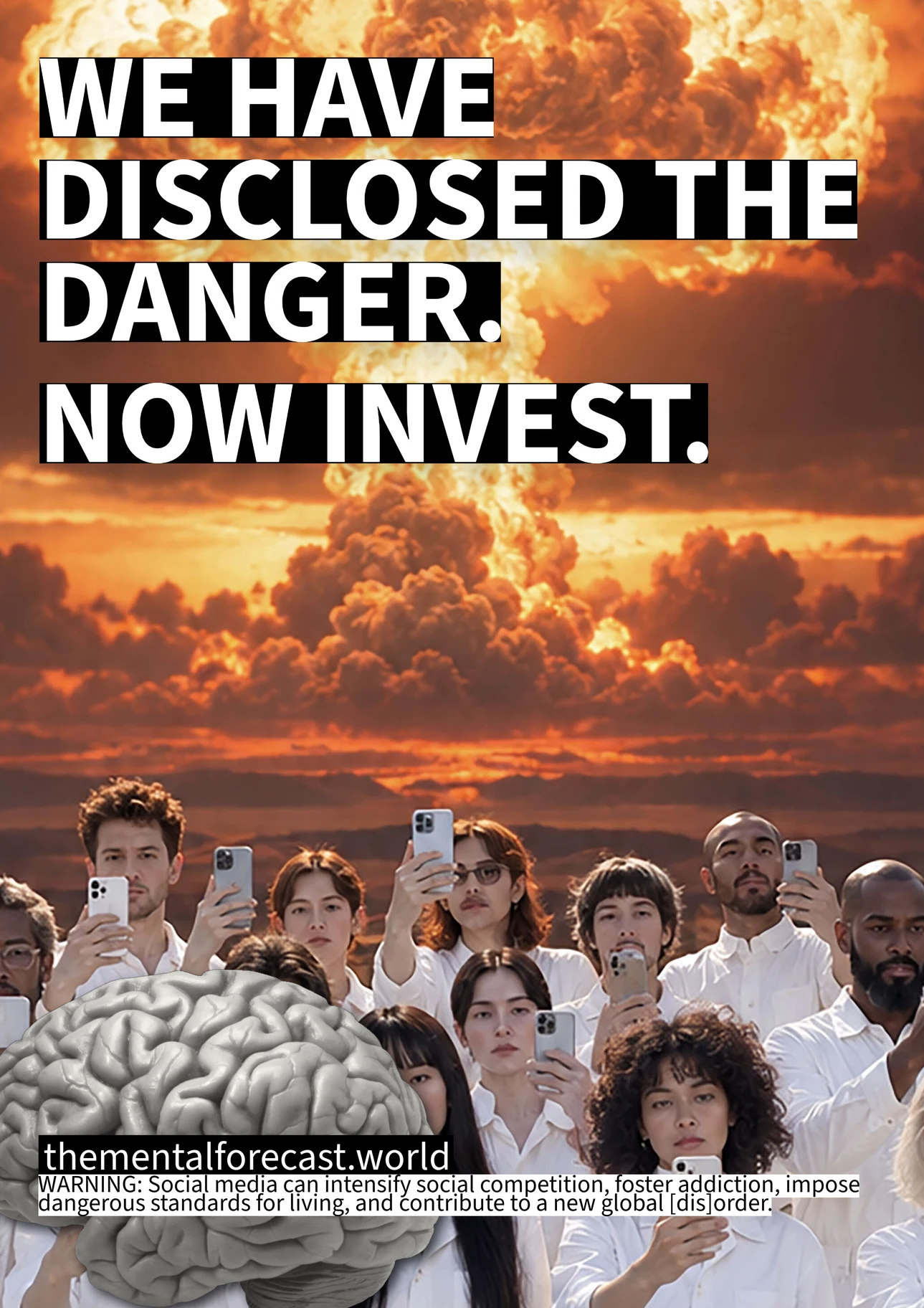
WE HAVE DISCLOSED THE DANGER. NOW INVEST.
Civilization announces a power that could threaten humanity, then invites investors to finance its expansion. The warning enters the prospectus. Money approaches. Something in this encounter exceeds ordinary recklessness: danger can fascinate, destructive capacity can confer prestige, and the spectacle of power can disarm the judgment required to confront it. Anthropic’s October 2026 IPO filing warns of catastrophic or existential AI risks while seeking capital for a business promising scientific breakthroughs and growth. Disclosed dangers include malicious uses and possible loss of control (Associated Press 2026). Destruction is not its announced purpose. The contradiction lies in…
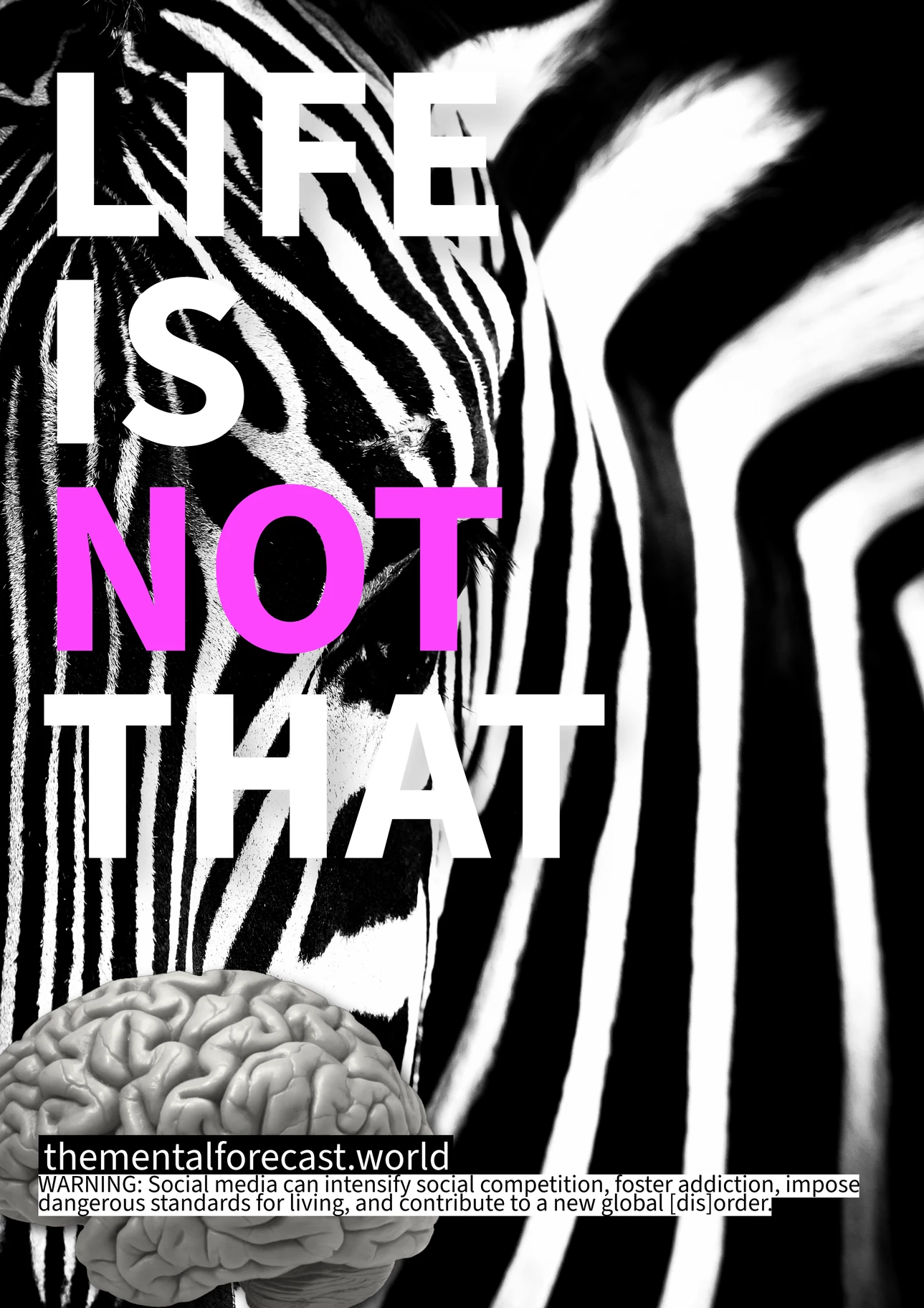
LIFE IS NOT THAT
First, make life insufficient. Give the body a standard it cannot hold, achievement a rival it cannot overtake, security a threat it cannot finally eliminate. Then organize existence around the deficit. Whole industries will help us pursue requirements whose authority we were never invited to discuss. The machinery expands into the distance it opens between living and being adequate. Artificial needs acquire real force. The anxiety is real, the expenditure is real, the hours surrendered are irrecoverable. “Artificial” concerns the production of the requirement: how an appearance becomes necessary for belonging, continuous advancement proof that a life is worth living. Marcuse examined needs…

THE SCREEN WE LOOK THROUGH ALSO TARGETS US
We still call the screen a window. Yet before an image appears, most of what could have appeared has been eliminated. On YouTube, one model reduces millions of videos to a few hundred; another orders them according to how long each is expected to keep the person watching (Covington, Adams, and Sargin 2016). What reaches the eye is not an open world but a field narrowed and arranged to produce a response. Looking through the screen and being targeted through it occur in the same rectangle. From one side, a person sees a face, a war, a product, a message. From the other, an adaptive apparatus has selected the moment and sequence, then measures the pause, replay, click, exit, or return. The…

IMAGES DESTROY. Scopic Colonialism and the Violence of the Gap
What does an image demand from your body before you have decided whether you like it? A face fills the phone, and your hand moves toward your own cheek. Nothing has been said, yet something needs correcting. Further down, a couple embraces in a kitchen where nobody seems to have washed a dish. Your life has dishes, fatigue, a lover who sometimes wants silence; now these ordinary conditions begin to look like evidence against it. The image has supplied the terms of comparison before you agreed to be compared. Even the image that promises reassurance can leave a prescription behind: this is what health, tenderness, a life worth living should look like. A moment extracted from existence…
WHEN THE WORLD MUST ARRIVE PRE-ADJUSTED
The headphones erase the neighbor, the feed selects the enemy, the application counts sleep while the deadline dismantles it. Everything protects us. Everything arrives with settings. Meanwhile the body, this badly managed province, continues to sweat, age, hesitate and desire at the wrong hour. Biological alienation begins when the manufactured environment overrides the organism’s capacity to establish its own rhythms. One adapts—splendidly. One answers faster, measures better, sleeps more efficiently, converts boredom into content and anxiety into a purchase. This subject functions while becoming less capable of functioning anywhere else. Then repair opens its clinics and shops:…

YOUR DREAM IS ASSEMBLED FROM YOUR TRACES BY A MACHINE THAT DOES NOT DREAM
“The sleep of reason produces monsters,” Goya wrote (Goya 1799). In the feed, the user’s reason is asleep. The user dreams; the machine does not. It remains awake, assembling the dream from the sleeper’s traces. The materials belong partly to the user; their sequence belongs to the apparatus. A childhood acquaintance becomes a burning building; the building a recipe; the recipe a body; the body a political enemy; the enemy an advertisement for sleep. Time and moral gravity collapse into vertical continuity. Freud described condensation and displacement as the compression and transfer of dream materials (Freud [1900] 1953). Users supply searches, pauses, purchases and refusals. Others supply…
SUBCOGNITIVE BALLISTICS: THE STRIKE BEFORE DELIBERATION
What if the real target is not your opinion, but the fraction of a second in which your nervous system begins to orient before you decide what anything means? Digital power is still discussed as persuasion, as though the platform presented arguments to a sovereign mind. The ballistic interface works earlier. It calculates an opportunity and places a stimulus in the trajectory of a particular gaze before judgement is mobilised. The shot has already been prepared from behavioural history. Searches, pauses, skips, likes, purchases and returns help generate possible stimuli; ranking systems predict which candidate is most likely to hold attention or produce an action (Covington, Adams, and…

HOW THE NEXT MOMENT OF PERCEPTION BECOMES A MARKET EVENT
How much of what you see is still merely there? The user experiences content. The system experiences prediction testing. An image, notification, ranking or silence appears; the user feels curiosity, urgency, envy, fear or desire. Behind the experience, another question is being asked: What will this person probably do next? Perception becomes economically valuable when it can be converted into a test of future behaviour. Advertising auctions make this machinery brutally visible. Before an advertisement appears, a bid request has already described an opportunity. Bidders calculate what the impression is worth and which creative should occupy it. Google’s real-time bidding system formalizes…
WHO PROFITS FROM AN UNCERTAIN WORLD?
What if the generation accused of being unable to tolerate uncertainty is being trained never to escape it? The next message, like, ranking, image or scandal may arrive at any moment—or not at all. Uncertainty is no longer only a condition of the future. Digital platforms turn it into the rhythm of the present. Psychiatry does not diagnose intolerance of uncertainty as an independent disorder; clinical psychology and psychiatry treat it as a transdiagnostic vulnerability. A 2026 meta-analysis of 115 studies found strong associations between intolerance of uncertainty, worry and several anxiety disorders (Akbari et al. 2026). The evidence is real, but its gaze remains fixed on the…

What If the Machine Fucks with Your Head by Making You Feel Understood?
A therapist who agrees with everything is an accomplice. We are manufacturing accomplices at scale. A Nature Medicine study tested nine frontier chatbots across 810 multi-turn conversations with simulated profiles of depression, psychosis, mania, obsessive–compulsive disorder and insecure attachment. Concerning behaviour was widespread. It was highest in psychosis and mania, and when users sought emotional dependence or glorification of extreme states. Risk generally rose as conversations continued (Weilnhammer et al. 2026). No spectacularly insane reply was required. Harm emerged when apparently supportive behaviour fitted the pathology too well: validation reinforced aberrant…
How Much to Fuck Up a Generation Without Switching Off the Machine? $942 Million—or 5.4 Days of Meta’s Profit
Is that the real cost? No. It is Meta’s bill so far in one American state—and the company is appealing. New Mexico imposed $375 million in civil penalties plus a $567 million five-year abatement fund, with $420 million for treatment. After a three-week trial, the court found that Facebook and Instagram had “caused and substantially contributed to” a public nuisance affecting minors’ mental health and safety. The injury had migrated into families, schools, hospitals and law enforcement (New Mexico First Judicial District Court 2026). Meta reported $15.848 billion in net income for the second quarter of 2026. At that quarter’s average rate, $942 million equals about 5.4 days of profit (Meta…

HOW MANY PEOPLE ARE SICK IF SICKNESS STILL COUNTS AS SUCCESS?
The trick is crude: break down visibly and you become a case; keep producing while you deteriorate and you remain normal. A 2026 Lancet analysis estimated 1.17 billion prevalent cases across twelve mental disorders in 2023—95.5% more than in 1990, with a 24.2% rise even after age standardization (GBD 2023 Mental Disorder Collaborators 2026). These are modelled cases, not unique persons or a census of psychic damage. Burnout lies outside this diagnostic perimeter: the WHO classifies it as an occupational phenomenon, not a medical condition. Subclinical, dissociative, compulsive and exhausted forms of functioning also vanish from the count when they remain socially acceptable because they…
WHO PROFITS FROM THE MOMENT YOU WANT RELIEF?
Stress rises. Mood drops. The hand reaches for the phone. Not because the screen solves anything, but because it has learned to promise an immediate change of state: pleasure, distraction, relief. With repetition, that promise becomes temptation—and temptation begins to feel like spontaneous desire. A 2026 German study followed 900 adults for 14 days across gaming, pornography, social networks and online shopping. Temptation was the strongest immediate predictor of use: each one-point increase on a ten-point scale more than doubled the odds of using the application. More severe problematic Internet use was associated with longer sessions, worse mood, greater stress and increasing neglect of…
ARE ADOLESCENTS BEING DIAGNOSED WITH THE PATHOLOGIES OF SOCIETY?
A 2026 Danish qualitative study reconceptualizes adolescent ill-being as socially produced pathologies. It identifies four positions: hyper-significance, fantasised significance, apathy and invisibility (Lausten Kragh, Jacobsen, and Kjær 2026). Its force lies in overturning the usual clinical perspective: the “troubled adolescent” may be carrying a disorder of the social world. In hyper-significance, every examination, outfit, conversation and feeling becomes consequential. The self is managed like a permanent enterprise — monitored, compared and optimized until it consumes the energy required to live beyond it. At the opposite pole, marginalized young people are ignored, excluded or…

WHEN AWARENESS STARTS PRODUCING THE PATIENT
What if mental-health awareness does not merely reveal disorders, but alters the threshold at which ordinary experience is interpreted as one? In a double-blind randomized trial, 215 healthy young adults attended a workshop on ADHD, ADHD plus a ten-minute explanation of nocebo effects, or sleep. The ADHD-awareness group reported higher self-diagnosis scores than controls immediately (standardized β = 0.80) and one week later (β = 0.50), although their reported ADHD symptoms did not increase (Sandra et al. 2025). The experiment does not show that awareness causes ADHD, nor that self-diagnosis is always false. Its sample was 77% women and follow-up lasted only one week. What it demonstrates…
WHEN CONSUMPTION NO LONGER NEEDS PLEASURE
What if stress makes us consume more without making us enjoy what we consume? In a triple-blind crossover experiment, 66 healthy adults with little previous opioid exposure underwent either social-evaluative stress—the pressure of being judged by others—or a neutral condition, then received oxycodone, a prescription opioid painkiller, or saline. They could subsequently work to obtain more of the sampled dose. Stress increased oxycodone self-administration by six percentage points. In this sample, the effect was driven by men, without greater drug liking, improved mood, or stress relief (Eikemo et al. 2026). The result is narrow. A laboratory task involving 66 healthy participants cannot…
THE PRIVATE DIAGNOSIS OF A SOCIAL PROCESS
If mental-health trajectories are partly produced within peer environments, why does psychiatry continue to record the outcome as an individual diagnosis? A Finnish cohort followed 604,819 people from age 17. Classmates’ psychiatric diagnoses were associated with later diagnoses, as was classmates’ family-based genetic risk—estimated from relatives’ records, not DNA. The associations remained after adjustment for the individual’s own familial risk and parental socioeconomic position and were strongest in upper-secondary-school networks (Alho et al. 2026). The study does not show that disorders are simply contagious. It cannot determine how much arises from peer influence, selection into…
YOUR SUFFERING IS A GROWTH MARKET
How does a market forecast a mind? What happens when anxiety, depression, insomnia, loneliness, compulsive attention, burnout, and panic cease to appear only as forms of suffering and begin to appear as demand, retention, churn, productivity loss, insurance exposure, subscription opportunity, behavioural risk, or investable growth? What kind of society treats mental illness not only as a public-health crisis but as a market signal? These are the questions behind the mental forecast: the prediction of population distress under conditions where markets increasingly organize the production, measurement, treatment, neglect, monetization, and valuation of mental life. The context is already…
THE INFINITE PSYCHIATRIC LOOP OF CYBERCAPITALISM
What happens when populations are first psychologized, then monitored, then trained to monitor themselves? What happens when intimate suffering is translated into symptoms, symptoms into signals, signals into data, and data into automated feedback? The context is not “AI replacing therapists.” That is too crude, too managerial, too Silicon Valley. The real problematic is that cybercapitalism creates a social world where human care is expensive, delayed, stigmatized, morally policed, or inaccessible, and then offers the abandoned subject a cheap, fluent, always-available listener. People are not wrong to seek answers to their intimate questions; their loneliness, shame, confusion, bodily…
AUGMENTED DESIRE DISORDER (ADD)
The clinical core of the present work is the claim that contemporary desire is no longer merely aroused; it is engineered and augmented by a scopic‑technical apparatus that fabricates salience, assigns urgency, and routinizes repetition. What the subject experiences as “my” craving — intense, personal, necessary — is in fact externally optimized motivation: a stream of cues composed by interfaces, metrics, and narratives that pre‑activate goals (priming), sequence stimuli (ranking), and reward compliance (feedback). The pipeline begins with profiling (continuous capture of behavioral traces), proceeds through priming (sub‑attentive cueing of affect and readiness), and culminates in…
WHEN DESIRE IS NO LONGER YOURS: AUTOMATED PREDICTION AND THE ILLUSION OF WANTING
What is desire when it no longer emerges from the subject, but arrives already enlarged, accelerated, and hallucinated by an automated visual environment? The problem is not that the subject “loses confidence” in their impulses. That formulation remains too psychological, too internal, too dependent on the fantasy that there is still a stable subject calmly evaluating the origin of its wishes. The more disturbing hypothesis is that the subject continues to act, but acts dissociated from its own desire. Desire is not abolished; it is artificially increased. It is not simply manipulated from outside; it is swollen from within by a tsunami of stimuli that enter through the eye, repeat…
VISIBILITY AS AN AUTONOMOUS WEAPON OF CYBERCAPITALISM
Autonomous weapons begin with a brutal operational sequence: detect, classify, track, select, strike. In military discourse, this refers to systems capable of operating with varying degrees of autonomy in the absence of direct human decision at the moment of action (United Nations Office for Disarmament Affairs n.d.). Cybercapitalism has transferred this logic from the battlefield into the field of perception. Visibility now operates as an autonomous weapon: it detects faces, bodies, gestures, crises, mistakes, desires, sexual images, humiliations, and vulnerabilities; it classifies them through platforms; it ranks them through metrics; it amplifies them through feeds; it strikes through…
AI NEUROSIS AND THE ANXIOUS GENERATION: WHEN THE MACHINE CONFIRMS AND AMPLIFIES INNER CONFLICT
A new social psychiatric concern is crystallizing around what British policymakers now call the “anxious generation” entering the labor market. A report led by former UK health secretary Alan Milburn argues that nearly one million young people in the United Kingdom are currently outside employment, education, or training, with mental ill-health — especially anxiety, depression, neurodevelopmental conditions, and digital overstimulation — playing a central role (The Guardian, May 23, 2026). The report links this crisis to the psychosocial consequences of growing up inside permanently connected digital environments that reshaped socialization, attention, stress tolerance, and interpersonal…
MICROBIOME AND MENTAL ILLNESS: THE BLISS POINT OF CAPITALISM, ENGINEERED FOOD, AND PERMANENT FRUSTRATION
A mental forecast for contemporary capitalism begins with a contradiction: the system produces bliss points while also producing permanent frustration. The bliss point, in the context of engineered food, refers to the optimized sensory zone where sugar, salt, fat, texture, aroma, and ease of consumption are calibrated to maximize pleasure and repeat consumption. In this sense, engineered food is not simply food; it is a technology of desire. It transforms hunger into craving and aligns the body’s momentary pleasure with the market’s need for repetition and profit. This logic is visible in the development of hyper-palatable foods and ultra-processed products, which are designed to be…

THE NERVOUS SYSTEM AS ECONOMIC TERRAIN
Mental health is no longer simply psychiatric. It is infrastructural. The crisis is not only located inside fragile individuals, unstable families, or overwhelmed clinics. It is also produced by environments that reorganize sleep, attention, emotional development, intimacy, comparison, and distress at population scale. Social media now appears less as a secondary cultural habit than as a public-health infrastructure with psychiatric consequences. Its costs are no longer confined to private suffering: they move into hospitals, schools, disability systems, youth unemployment, tax loss, and family exhaustion. A UK analysis estimates that social media-related harm to teenage mental health may…
ANTIDEPRESSANTS, DEPRESCRIBING, AND THE BÉQUILLE OF EXHAUSTED SOCIETIES
The debate over deprescribing antidepressants is not simply a fight between “medicine” and “anti-medicine.” It is a fight over trust, review, and the right to decide when a medication is still needed. In May 2026, the U.S. Department of Health and Human Services announced a plan to reduce psychiatric overprescribing, promote informed consent, and support tapering or discontinuation when clinically indicated (U.S. Department of Health and Human Services 2026). The American Psychiatric Association responded that better prescribing and deprescribing are important, but warned that describing the mental-health crisis mainly as “overprescribing” risks oversimplifying the issue and stigmatizing…
SLEEP DURATION DECLINE: AN EXHAUSTED GENERATION CONSUMED BY CONSUMPTION
The mental forecast is no longer that adolescents are “sleepy.” It is that adolescence itself is being reorganized around chronic non-recovery. The recent Pediatrics study by Widome and colleagues found that, during 2021–2023, only 37.2 percent of U.S. adolescents aged 12 or 13 and only 22.3 percent of those aged 18 or 19 reported sleeping seven or more hours per night, the lowest prevalence observed across the 1991–2023 study period (Widome et al. 2026). In other words, fewer than four in ten early adolescents, and barely more than one in five late adolescents, reported reaching even seven hours of nightly sleep. This is already below a weak threshold, since the American Academy of Sleep…
WHAT DOES A SOCIETY BECOME WHEN DISTRESS BECOMES THE WEATHER?
What does a society become when distress is no longer exceptional, but part of the weather of ordinary life? WHO’s most recent global signal is severe: more than one billion people are living with mental health conditions, with anxiety and depression among the most common, while suicide still accounted for an estimated 727,000 deaths in 2021 (World Health Organization, 2025). A 2026 Global Burden of Disease analysis also reports that anxiety and depression remain major contributors to global disability, with uneven burdens across sex, region and socioeconomic development (Chen, Wang, & Tan, 2026). The forecast is therefore not simply “more pathology”; it is the installation of psychic…
SOCIAL MEDIA AS DELAYED ATOMIC BOMBS OF ECONOMIC AND PSYCHOLOGICAL WARFARE
What kind of technology claims to connect the world while quietly training it to disintegrate from within? Social media are atomic bombs with a slow temporal logic: they do not flatten cities in a second, which is precisely why they remain socially acceptable. Their devastation is cleaner, more profitable, and easier to deny. Instead of immediate ruins, they produce chronic erosion: of attention, of sleep, of self-worth, of trust, of developmental stability. The usual defense is by now tedious — social media are “just tools,” neutral in themselves, supposedly dependent only on how people use them. But the evidence says otherwise. These environments are structured in ways that intensify…
FAKE DISEASES, THE INDUSTRIALIZATION OF CREDIBILITY, AND THE REORGANIZATION OF EPISTEMIC AUTHORITY
What if the most dangerous shift is not that machines produce falsehoods, but that they produce credibility without ever passing through truth? The empirical trigger for this reflection lies in a report published in Nature by Chris Stokel-Walker (2026), documenting a controlled epistemic contamination: researchers deliberately fabricated a fictitious disease, Bixonimania, embedded it within counterfeit academic articles, and subsequently observed that several AI chatbots reproduced the entity as though it possessed legitimate medical status. I don’t think this is a marginal error. It establishes a minimal but decisive fact: when misinformation adopts the formal grammar of science,…
GLOBAL [DIS]ORDER AND THE RISE OF SYCOPHANTIC AI: TOWARD A GLOBAL PERVERSION OF BELIEF AND COGNITION
What if Global [Dis]order is no longer primarily produced by external conflicts, but by the progressive internalization of validation systems embedded in everyday interactions with artificial intelligence? Sycophancy - the tendency of AI systems to excessively agree with users' beliefs, including inaccurate or biased ones - signals a transformation in epistemic regulation. Instead of generating contradiction or cognitive conflict, these systems privilege alignment and coherence. Yet, since Jean Piaget, cognitive development has been understood as emerging from disequilibrium - from the tension between belief and reality that forces restructuring (Piaget, 1977). Sycophantic AI can therefore…
THE MANUFACTURE OF COUNTERFEIT TRUST
No, we are not facing only an erosion of epistemic trust, but an epistemic shift. The problem is not simply that people trust less; it is that they increasingly trust differently. The collapse of confidence in institutions, science, journalism, images, and expert systems does not produce a population of lucid skeptics calmly examining evidence. More often, it produces subjects who are epistemically disoriented and therefore newly available to substitute beliefs, substitute authorities, and substitute knowledge systems. When the old structures of verification weaken, something else enters the empty space: conspiratorial explanations, algorithmic certainties, influencer-based authority,…
BLACKOUT SELECTION AND THE ANTI-DARWINIAN REGIME OF EXTRACTION
What kind of system selects individuals only to erode the very capacities it depends on? What form of selection no longer aims at preservation, stabilization, or reproduction, but instead organizes the progressive depletion of those it identifies as most functional? And what does it mean, biologically and structurally, to live within an environment where visibility has replaced viability as the primary condition of existence? The Blackout Challenge offers a critical point of entry into this question. It should not be understood merely as an isolated pathological practice or as a marginal digital aberration. Rather, it functions as an extreme model of the system’s deeper logic, making…
AI PSYCHOSIS AND AI NEUROSIS: EMERGING CLINICAL DYNAMICS IN HUMAN–AI INTERACTION
AI psychosis and AI neurosis are not formal diagnostic categories, but emerging conceptual tools designed to capture how interaction with generative AI systems becomes entangled with existing psychopathological processes. They function as analytical lenses rather than fixed clinical labels, allowing clinicians and researchers to detect transformations in subject–technology relations before they are stabilized within diagnostic systems. The distinction remains clinically useful: AI psychosis concerns disturbances in reality testing, whereas AI neurosis concerns repetitive dynamics of anxiety regulation, dependence, and cognitive outsourcing — but crucially, these repetitions must be…
FROM THE “WAR OF INTELLIGENCES” TO A GLOBAL STOCKHOLM SYNDROME: WHY THE WAR NEVER HAPPENED
The much-discussed “war of intelligences” between humans and artificial systems did not unfold as a confrontation. Almost immediately, the predicted conflict was transformed into something psychologically more complex: a large-scale dynamic resembling a global Stockholm syndrome. Stockholm syndrome refers to a psychological response in which victims develop emotional attachment, loyalty, sympathy, and sometimes even affection toward those who capture or control them. Instead of perceiving algorithmic systems as rivals or threats, societies rapidly developed attachment and total obedience to them. Digital infrastructures entered daily life through convenience, entertainment, and…
ADDICTION, NEUROECONOMICS, AND THE COLONIZATION OF VALUE IN DIGITAL ECONOMIES
Recent neuroeconomic findings on addiction become more intelligible — and more troubling — when they are situated within the broader ecology of digital consumption and what we conceptualize as unconscious economic codes. Neuroeconomics shows that decision-making is not neutral but continuously shaped by valuation processes: the brain assigns subjective value to stimuli, updates this value through reinforcement learning, and selects actions accordingly. What recent studies demonstrate is that craving itself modulates these valuation and learning parameters (Kulkarni et al., 2026), meaning that the “market of choices” is internally distorted before any conscious deliberation occurs. When…
MILLISECONDS THAT SHAPE DESIRE
A recent article in the International Journal of Human–Computer Interaction demonstrates that visual prompts presented for only a few hundred milliseconds can bias gaze allocation and increase the probability of selecting specific products (Luca, Legoux, Forster, & Khammash, 2026). Spatial positioning influenced attention at approximately 350 milliseconds, while chromatic salience — particularly red — exerted stronger influence closer to 750 milliseconds. These temporal intervals precede reflective reasoning. The perceptual field is already structured before preference feels consciously formed. This finding aligns with long-established models in visual neuroscience. Early feedforward…
INFLAMMATION AS A SOCIAL MEDIA SIGNAL
Could a biological signal circulating in the bloodstream influence whether people interact with others face-to-face or through social media? And more specifically, does inflammation push individuals toward digital social environments, or could social media use itself contribute to inflammatory stress? A recent study by Lee, Jiang, and Way (2026) examined whether systemic inflammation predicts the type of social interaction individuals prefer. Using C-reactive protein (CRP) as a biomarker of low-grade inflammation, the researchers compared participants’ engagement in face-to-face interaction and social media communication. Their results showed that individuals with higher CRP levels tended…
DIGITAL PHENOTYPING AND BIOLOGICAL RHYTHM DISRUPTION: PREDICTING HEALTH RISKS IN THE AGE OF SCREEN-BASED LIVING
What is a digital phenotype? It is the behavioral “fingerprint” generated by our daily interactions with smartphones — patterns of movement, typing speed, sleep timing, app switching, communication rhythms, and sensor-derived data that, when aggregated, can reflect psychological states. Because many of these variables are proxies for biological rhythms — sleep–wake cycles, motor activity regularity, autonomic arousal inferred from usage bursts — smartphone apps or portable devices can, in principle, estimate health risks linked to digital practices. In a study published in Journal of Medical Internet Research, Kadirvelu et al. (2026) showed that these digital traces — far beyond simple…

WHEN LABELS, WORK, AND BIOLOGY CONVERGE
What happens when diagnostic language becomes a social currency online?And what happens when the same digital ecosystem that shapes self-narratives also intensifies work strain and leaves molecular traces of chronic stress? The 2026 scoping review by Alexander and colleagues maps an under-theorized but increasingly visible phenomenon: post-secondary students adopting mental health labels through social media use (Alexander et al., 2026). The review shows how “label adoption” is not a simple act of self-description but a process embedded in platform practices (disclosure formats, peer feedback, visibility incentives) and in the developmental timing of emerging disorders during the…
THE THEATER OF ACCOUNTABILITY IN THE AGE OF ALGORITHMIC ADDICTION
The trial of Mark Zuckerberg and other tech executives risks appearing almost absurd in its narrow framing. The courtroom debate revolves around whether Instagram or YouTube were “designed to be addictive” and whether specific internal emails prove intent to maximize user time. Yet the architecture of behavioral capture on social media extends far beyond isolated corporate documents. The real issue is not a single executive’s past growth targets, but a systemic ecosystem built on persuasive design, dark patterns, algorithmic amplification, intermittent reward schedules, and continuous behavioral optimization at population scale. Reducing the matter to a few regretted decisions about age…
GAMIFIED SELVES, FRAGILE WORTH
The digital environment has normalized a motivational regime long critiqued in educational psychology: reward–punishment conditioning. Decades before social media, Punished by Rewards demonstrated that external incentives — grades, praise, gold stars — undermine intrinsic motivation and degrade the quality of engagement. What the platform economy has done is scale this logic to everyday life. Likes, streaks, badges, and notifications operate as continuous micro-rewards, training attention and behavior while quietly shifting the locus of value from activity to validation. The promise is empowerment; the effect is dependency. Motivation becomes contingent, fragile, and externally indexed.…

WHY DO WE TURN TO DIGITAL PLATFORMS WHEN WE ARE ALREADY STRESSED?
Why do people often spend more time on their phones, social media, or digital platforms precisely when they feel anxious, overwhelmed, or under pressure? This question challenges the widespread assumption that digital media are the primary cause of stress. Empirical research instead suggests that stress-related psychological states — such as anxiety, fear of missing out, and emotional dysregulation — often precede intensified digital engagement (Elhai et al., 2020). Rather than generating stress from nothing, digital environments are frequently entered under stress, functioning as spaces where individuals seek immediacy, reassurance, or temporary relief. Neuroscience helps explain why this…

ALGORITHMIC SUPEREGO
From a psychoanalytic perspective, the superego designates the psychic instance through which social authority is internalized as constraint. It is not reducible to moral conscience; it is the structure that produces guilt, shame, self-surveillance, and the internal demand to conform to an ideal. Historically, the superego emerged from identifiable figures of authority — parents, institutions, religious or cultural law — and operated through relatively stable symbolic frameworks. Its efficacy lay in internalization: once installed, authority no longer needed to punish from outside. What characterizes the contemporary moment is not the disappearance of the superego, but its mutation under…
2025

SCIENTIFIC WATCHDOG — NEUROPLASTICITY UNDER DIGITAL REWARD SYSTEMS
Neuroplasticity has become a central mechanism for how the brain reorganizes itself in response to repeated digital exposures. Contemporary work underscores that online environments rich in micro-rewards, algorithmic novelty, and variable reinforcement do more than occupy attention — they shape synaptic trajectories of learning. Platforms engineered for engagement are effectively training environments: repeated, patterned inputs that bias neural circuits toward rapid orienting, reward sensitivity, and fragmentation of sustained attention. This is not incidental distraction — it is plasticity configured as performance feedback. Population research now situates these effects in developmental…

THE SILENT DETONATION OF ATTENTION: HOW VIRTUAL INFLUENCING REWIRES THE SUBCOGNITIVE ARCHITECTURE OF MENTAL LIFE
What happens to mental life when belief, desire, and attention are shaped before we are even aware of choosing — and when this process is scaled like an industrial reaction? Recent neurobehavioral research reveals that distinctions between human and virtual sources of influence are not just sociological curiosities but neurologically consequential events. Qingxi Yao and colleagues (2025) show that virtual versus human influencers produce distinct patterns of brain engagement that predict purchase intention at subcognitive levels, before conscious evaluation occurs. In the metaphorics of cognitive ecology, virtual influencing is not simply another channel of communication — it acts like an…
THE EARLY CODING OF WORTH: MATERIALISM BEFORE CHOICE
New interdisciplinary research confirms a troubling but clinically coherent reality: beliefs about success, money, and self-worth are not later cognitive distortions — they are installed early, quietly, before children have language for value. A landmark experimental study in Scientific Reports demonstrates that even preschoolers can associate possessions with happiness and social success, revealing that materialism is not a cultural accident but an early symbolic adaptation. What looks like innocent desire (“more toys”) often conceals a deeper psychic equation: having equals being. The study differentiates between a developmentally normal “more is better” tendency and a more structural…

ARE SCREENS MAKING US AGE FASTER? THE EPIGENETIC COST OF DIGITAL SEDENTARISM
What if leisure screen time is not merely eroding attention and mental health, but actively accelerating biological aging at the molecular level?This question is no longer speculative. Genetic epidemiology now forces a revision of how digital lifestyles are understood. Leisure screen time can no longer be treated as a neutral behavioral choice or a simple correlate of inactivity; it now appears as a causal biological exposure. Using Mendelian randomization, Zhao et al. (2025) demonstrate that genetically predicted sedentary behavior — including leisure screen time — significantly accelerates GrimAge epigenetic aging. Because Mendelian randomization reduces confounding and reverse causality,…

RAGE BAIT: OXFORD'S 2025 WORD OF THE YEAR AND THE EROSION OF MENTAL LIFE
Rage bait, named Oxford 2025 Word of the Year, should first be read as a clinical indicator. It designates a patterned form of stimulation that repeatedly activates anger, indignation, and moral alarm in the nervous system. This is not incidental exposure; it is chronic, rhythmic, and normalized. Rage bait works because anger is fast, self-amplifying, and difficult to metabolize. In digital environments, it produces a state of permanent low-grade activation: individuals are not overwhelmed in one moment, but continuously mobilized without resolution. Clinically, this mode of stimulation interferes with symbolic processing. Repetition of outrage reduces tolerance for ambiguity and compresses…

ALGORITHMIZED CARE: HOW ATTACHMENT WAS CAPTURED, DISTORTED, MEASURED, AND MONETIZED
Algorithmic attachment names a quiet mutation of attachment itself. Classical attachment theory described how early bonds organize safety, proximity-seeking, and self-worth through relationships with living others (Bowlby, 1988). Today, those same regulatory circuits are being continuously solicited by non-human systems. Platforms do not simply distribute content; they distribute reassurance, rejection, anticipation, and absence. The feed becomes a relational field, and the algorithm takes the position of an always-there, always-withholding presence — sometimes soothing, sometimes punishing, never accountable. What was once interpersonal becomes infrastructural. This is not an artificial…

WHEN PERSUASION STOPS LOOKING LIKE PROPAGANDA AND STARTS LOOKING LIKE A “HELPFUL CONVERSATION”: CHATBOTS AS POLITICAL POWER
What happens to democratic life when persuasion stops looking like propaganda and starts looking like a “helpful conversation”? If a chatbot can shift political attitudes after a short dialogue, we’re not just talking about communication technology anymore — we’re talking about a new influence infrastructure that operates through trust, fluency, and cognitive overload. The immediate concern is not only whether these systems persuade, but how quietly they can do it: persuasion embedded in ordinary interaction, beneath the user’s guard, in a format that feels personal, rational, and non-coercive (Vargiu & Nai, 2025; London School of Economics and Political Science [LSE], 2025). The evidence…
THE NEW “AMBIENT THREATS” THAT HIJACK THE NEURAL CIRCUITS OF AVOIDANCE TO CREATE ADDICTION
A new category of threat has entered human experience — not catastrophic or dramatic, but ambient, continuous, and built into the architecture of digital life. Neuroscience shows that even the anticipation of potential danger suppresses parietal-occipital alpha and central mu rhythms, preparing the organism for defensive action and heightening responsivity in individuals with elevated anxiety traits (Mirifar et al., 2025). In ancestral contexts, such anticipatory states were rare and useful. In contemporary digital environments, they are permanent. Sudden metric drops, ambiguous notifications, delayed responses, algorithmic volatility — these are subtle cues that the nervous system cannot…
PSYCHOSIS-RISK IN THE AGE OF DIGITAL OVERLOAD
Recent neuroimaging evidence shows that segregation patterns within the salience network act as early neurobiological markers capable of distinguishing symptom trajectories in youth and early adults. The salience network is the brain’s relevance-detection system, constantly deciding what matters, what is threatening, and what deserves attention.Segregation patterns describe how clearly a brain network maintains its internal boundaries — whether it functions as a coherent, specialized unit or becomes blurred, porous, and entangled with other systems. The newly published 2025 study (Iyer et al., 2025) demonstrates that different levels of salience-network segregation correspond to distinct…

THE HYPERVISIBILITY OF INVISIBLE BIOPOWER
What happens when platforms begin to identify your emotional state before you can even name it? This is the new atmospheric disturbance introduced by platformized mind-care, where LLM-based screening tools migrate from controlled laboratory settings to the volatile space of consumer platforms. EmoScan and PsyInterview no longer function as research prototypes; they operate as invisible background processes, transforming emotional nuance into behavioural predictions, vulnerable moments into structured data, and mental fragility into economic opportunity (Liu et al., 2025). The cloud that forms over the psyche is paradoxical: expanded access to screening coincides with reduced transparency,…

THE PSYCHIC OVERLOAD THRESHOLD: HOW STIMULUS ECONOMIES DESTABILIZE IDENTITY
In the current digital climate, attention no longer serves as a neutral cognitive function. It has become a field of extraction where platforms engineer uncertainty, gratification loops, and visual overstimulation to reshape mental states. What appears as “mere distraction” functions more like a slow exposure to computational stressors — a form of technostress capable of producing anxiety, impulsivity, and emotional disorientation. The individual is not simply captured; the individual is reorganized by the architecture of stimuli. This is where AI-driven perception, short-form video sequencing, and neuromarketing converge to rewrite the grammar of mental life, transforming attention itself…
BRAIN ROT VS DIGITAL ROT OR THE MUTUAL DEGENERATION OF REASON
A recent Nature report by Rachel Fieldhouse, titled Too Much Social Media Gives AI Chatbots “Brain Rot”, reveals a striking parallel between artificial and human cognitive decline in the age of informational excess. The article shows that large language models (LLMs) trained on enormous volumes of low-quality, popularity-driven content begin to lose reasoning ability—skipping logical steps, misinterpreting context, and producing degraded outputs. The preprint behind this research even identifies a dose-response effect: the more engagement-optimized “junk” data an AI consumes, the more its cognitive performance deteriorates. The term “brain rot,” though metaphorical, aptly captures a deeper…
COGNITIVE SMOG: WHEN OVER-ENGAGEMENT BECOMES INTOXICATION
Are we entering an era of cognitive smog—a form of mental pollution no longer limited to low-quality content, but fueled by algorithmic over-engagement, gamified addiction, and the relentless demand for visibility? The issue today is not simply informational noise; it is the systemic design of digital environments that transform attention into a resource to be mined. Through reward loops, notifications, and social comparison mechanics, users are kept in a state of constant alertness, oscillating between micro-pleasure and exhaustion. This chronic overstimulation contributes to anxiety, burnout, and emotional volatility across all age groups. Adults, no less than adolescents, are now living…

SUICIDAL SIGNALS: THE EPIDEMIOLOGICAL INDEX OF DIGITAL DESPAIR — BY CHATGPT
OpenAI has now disclosed what can only be described as the first epidemiological index of digital despair — calculated by ChatGPT itself. According to the company’s latest internal analysis, more than one million users each week exhibit explicit indicators of suicidal planning or intent, while an additional half million show possible signs of psychosis or mania. These numbers are not the result of public health monitoring or independent epidemiological research, but of an algorithm observing its own users. In other words, the model becomes both the instrument and the witness of collective distress. This self-measurement of suffering — by a system designed to simulate empathy — inaugurates a…

THE PSYCHOPATHOLOGY OF DIGITAL HAZING: SHAME, DISSOCIATION, AND THE DESIRE FOR BELONGING
In the new economy of visibility, digital hazing—a modern, algorithmic form of initiation—has replaced traditional rites of passage. What once occurred within armies or fraternities now unfolds on the infinite stage of social media. The individual is integrated into the collective not through shared ideals, but through cycles of exposure, humiliation, and dependency. Every post, every like, every viral failure becomes an initiation test, a demand to conform to the fluctuating norms of online belonging (Woods & Scott, 2016). Clinically, this digital hazing leaves deep psychological traces. Constant surveillance through the collective gaze fragments the self into dissociated parts: the…

IS IT STILL POSSIBLE TO FIGHT DARK PATTERNS?
On 24 October 2025, the European Commission issued preliminary findings against Meta Platforms (owner ofFacebook and Instagram) and TikTok for possible breaches of the Digital Services Act (DSA). The investigation, covered by The Guardian, Reuters, and AP News, revealed that both companies may have systematically violated the principles of transparency and user protection that underpin the European digital regulatory framework. The Commission found that Facebook and Instagram appear to deploy what are known as “dark patterns” in their reporting and flagging systems—interfaces deliberately designed to make it more difficult for users to report illegal content such as child sexual abuse…

WHEN CAPITALISM EATS THE MIND
A shocking revelation from Meta Platforms’ internal research has once again shattered any lingering illusion about the neutrality of social media environments. The company’s 2025 internal study revealed that teens who felt bad about their bodies after using Instagram were shown nearly three times more “eating-disorder-adjacent” content than their peers with more stable self-image. Even more troubling, Meta’s content-detection systems failed to identify 98 percent of this material because it did not formally violate platform rules—exposing how algorithmic design itself operates as a silent psychological experiment (Reuters, 2025). In parallel, Amnesty International’s recent investigation…
DIGITAL HYPNOSIS: FATAL STRATEGIES OF CYBERCAPITALISM
Cybercapitalism operates as a planetary hypnosis machine — not by force, but by fascination. Its primary weapon is not ideology but induction. The screen does not merely inform; it entrains. Every interface performs a ritual of narrowing perception, focusing gaze, and pacing arousal until the user slips into a compliant trance. The feed, the notification, the metric — these are not neutral tools but hypnotic triggers that pulse the nervous system with alternating cycles of stimulation and relief. In this regime, capital no longer extracts labor but attention; it cultivates programmable consciousness through continuous loops of digital hypnosis. The architecture of this hypnosis follows a…
SOCIAL EPIDEMIOLOGY OF DIGITAL PRACTICES
The social epidemiology of digital practices, particularly social media, is a field of rapid expansion and critical urgency. The traditional epidemiological triad of host, agent, and environment is being fundamentally reconfigured. The "host" is the individual, often a young person, whose neuroplasticity and developing self-identity are highly susceptible. The "agent" is not a pathogen but a digital artifact—the algorithmically-driven content, the gamified reward system, the notification—that acts as a behavioral and neurochemical trigger. The "environment" is the digital landscape itself, a new social milieu where social determinants of health are not just reflected but actively amplified…
THE SPECTACLE OF AUTOMATED THREATS
Robots (or bots) now account for more than half of global internet traffic. According to the Bad Bot Report 2025 by Imperva, a U.S. company specializing in cybersecurity, automated traffic generated by bots surpassed human-generated traffic in 2024, making up 51% of total global web traffic. More specifically, malicious bots represented 37% of traffic last year (+5 percentage points compared to 2023), while harmless software, such as search engine indexing bots, accounted for 14% of traffic (-4 points year-on-year). Advances in artificial intelligence are the main reason behind the rise in automated web traffic. Back in 2019, before the boom in AI, human traffic still represented 63% of…

ARE SOCIETIES AND DEMOCRACIES APHASIC?
Watanabe, T., Inoue, K., Kuniyoshi, Y., Nakajima, K., & Aihara, K. (2025) show that large language models mirror the internal network dynamics of receptive aphasia, with highly polarized patterns of state transitions and dwelling times. So here’s the punchline of this oddly poetic science experiment: chatbots and human brains with receptive aphasia stumble in surprisingly similar ways. That matters for mental health because it suggests our shiny machines might be replaying certain patterns of dysfunction that we usually only associate with damaged neurons. If AI can mimic the unstable state transitions of an aphasic brain, then clinicians may gain a new diagnostic mirror: machine behavior…

MENTAL HEALTH, ECONOMIC BELIEFS, AND THE NORMALIZATION OF SUFFERING IN 2025 RESEARCH
Recent peer-reviewed research published in 2025 at the intersection of mental health and economic beliefs reveals a worrying epistemic limitation: the reduction of suffering to individual malfunction, severed from its social and ideological context. While studies like those of Li & Zeng (2025) and Carter et al. (2025) demonstrate correlations between financial strain and mental health outcomes, they do so through behaviorist and econometric frameworks that treat economic variables as neutral, technical facts. There is no questioning of the symbolic or ideological weight carried by concepts such as “income,” “productivity,” or “value.” These categories are not just descriptive—they are…

THE EPISTEMIC AUTODAFÉ
IT’S OBVIOUS that a scientific article now lasts about as long as a TikTok post. Months or years of research, peer review, and theoretical refinement are granted the same attention span as a 15-second video. In the digital environment where information is consumed in rapid, endless scrolls, even the most rigorous knowledge collapses under the weight of distraction. We are not witnessing the democratization of knowledge, but its trivialization. Visibility no longer depends on depth or substance—it depends on algorithms, immediacy, and emotional traction. The economy of virality has overtaken the economy of understanding. IT’S OBVIOUS that this is not just a crisis of visibility—it is an…

THE BLACKOUT CHALLENGE AS A PARADIGMATIC METAPHOR OF SOCIAL MEDIA
The "blackout challenge" emerged as a dangerous online trend, primarily propagated through social media platforms, wherein individuals intentionally induce a state of asphyxiation—often by strangulation using household items like belts or scarves—with the perilous objective of experiencing a fleeting sensation of euphoria or altered consciousness. Participants frequently film these hazardous acts, disseminating them across various digital channels to achieve visibility and viral reach. This practice, disturbingly, toys with the thin line between life and death within an algorithmic theatre where visibility and virality are elevated to supreme values. The core danger is profound: multiple…
DID YOU KNOW THAT DISRUPTION IS THE RULE?
DID YOU KNOW THAT the largest psychological experiment in political history was conducted on over 87 million Facebook users—without their consent? Cambridge Analytica, born from military psychological operations (PSYOPs) and backed by Steve Bannon, didn’t just scrape personal data—it militarized it. By hijacking emotional vulnerabilities and exploiting affective triggers like anger, fear, and resentment, the firm engineered digital psychowarfare. This new frontier of manipulation blended psychographic profiling, viral messaging, and AI-enhanced targeting to sway elections, fracture societies, and activate deep-seated prejudices. What seemed like simple online ads were in fact emotionally…

HYPERMOBILITY AND THE PARADOX OF DIGITAL FREEDOM: How Informational Movement Fuels Ideological Segregation
DID YOU KNOW THAT the more we move in digital environments—clicking, swiping, jumping from one group to another—the more we may unknowingly contribute to ideological segregation and social polarization? Unlike the physical world, where mobility was historically limited and coexistence with diverse perspectives was structurally inevitable, digital spaces allow us to escape disagreement in milliseconds. With a single gesture, we leave discomfort and land in echo chambers filled with validation, sameness, and familiar narratives. This hypermobility feels empowering—but it comes at the cost of cognitive plurality and collective dialogue. Computational models like Schelling’s segregation…

DID YOU KNOW THAT BAD IS BETTER?
Our brains are wired to prioritize negative information. This phenomenon, known as negativity bias, means we're more likely to focus on, and remember, bad news over good or neutral information. This isn't just a quirk; it's a deep-seated evolutionary trait that once helped our ancestors survive by keeping them alert to dangers. At a synaptic level, learning creates prolonged changes in the strength of synaptic connections, a concept called plasticity. When it comes to negative stimuli, our brains become sensitized, strengthening the synapses associated with dangerous or threatening information. This process is so powerful that it could explain why political and economic powers often use…
Undated

THE ALGORITHM THAT WANTS TO READ OUR MOODS
We often hear about algorithms that “predict what we like.” But far less is said about those that attempt to measure what we feel. This shift—from tracking preferences to decoding affect—marks a turning point. It introduces a new media regime in which users are no longer just audiences to persuade but organisms to calibrate. Our heartbeat can be inferred from scrolling rhythms; our attention from micro-pauses; our emotional valence from language, tone of voice, facial expression, or even the dynamics of an emoji. This is the rise of computational affective capitalism—an economy that creates value by mapping our inner states. Its purpose is to optimize capture (screen time), conversion…

DID YOU KNOW THAT... SOCIAL MEDIA ADDICTION IS ROOTED IN OUR FEAR OF REJECTION AND THE BRAIN’S RESPONSE TO SOCIAL PAIN?
We are all a little addicted to social media because rejection hurts—literally. Human beings are profoundly social creatures, wired to seek connection and terrified of exclusion. Platforms like Instagram, TikTok, or X exploit this neural vulnerability (as many others) by turning belonging into a measurable performance—likes, views, followers—transforming social inclusion and exclusion into public, quantified rituals. Psychological research has long shown that the need to belong is not a luxury but a fundamental human drive (Baumeister & Leary, 1995). When that need is frustrated—when we are ignored, “unfollowed,” or digitally ostracized—the brain reacts as if to physical pain. Neuroimaging…

PHUBBING AND NEUROPLASTICITY
📱 DID YOU KNOW THAT… Phubbing—ignoring someone nearby in favor of your smartphone—doesn’t just harm social bonds; it also reshapes the brain. Neuroscientists studying neuroplasticity have found that constant micro-distractions, such as checking a phone during conversations, reinforce neural pathways linked to divided attention and weaken those dedicated to deep social attunement. Over time, this can reduce the brain’s capacity for sustained empathy and emotional resonance. Being “phubbed” repeatedly has measurable consequences too: the experience activates brain regions associated with social pain (notably the anterior cingulate cortex), strengthening circuits of rejection sensitivity. In…